Blog
What Makes a Business Website Look Outdated in 2026?

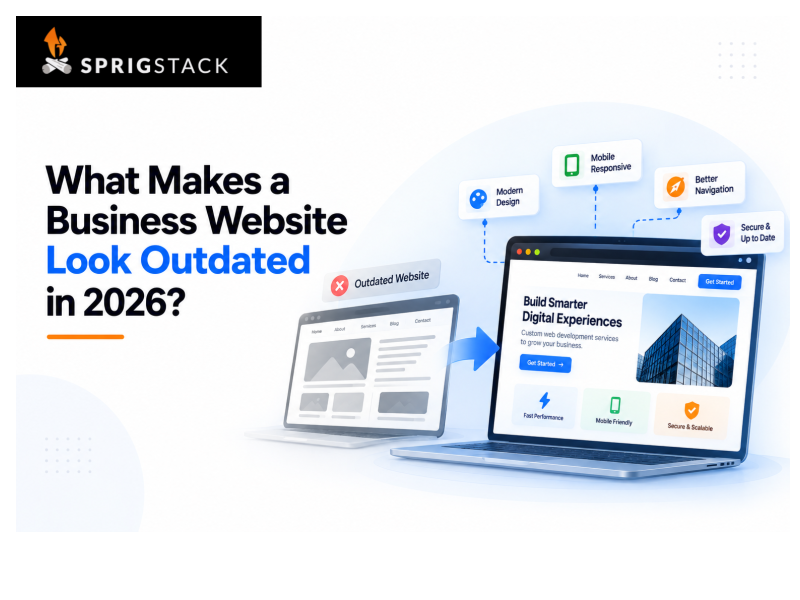
Nowadays, most customers judge a website and businesses by its appearance even before they connect with the company.. Acknowledge that the first impression counts even in 2026. After visiting your site, your clients will decide whether the company is worth their investment and time in a few seconds. The site, which was quite presentable several years ago, may give the impression of being abandoned, simply because the navigation, design conventions, and expectations of the user changed way more significantly.
If a business website does not meet the expectations of visitors, then they are more likely to leave, enquiries will dry up, and competitors with cleaner and faster sites will take those potential customers. That’s why many companies resort to custom web development services when a template-based site can no longer meet customer expectations and business needs.
Here are some of these real signs that will make a business website look old-fashioned in 2026 and practical ways to remedy each.
1. Slow Loading Speed and Poor Performance
Speed is often the first sign of quality that visitors see, even if they never consciously think about it. People will bounce back to the search results if pages take a few seconds or more to load, and slow sites tend to rank lower over time.
The biggest problems these websites have are uncompressed images and videos, a tonne of third-party scripts and plugins that have piled up over the years, and old hosting that can’t cope with busy periods. The biggest gains are usually achieved by compressing media, getting rid of unused plugins, and moving to modern hosting with a content delivery network.
2. Mobile Experiences that Don’t Respond
Most users these days explore a company’s website through a mobile device. A site that is not optimized for mobile devices is therefore a critical issue. Having a responsive design that looks good both on a desktop and on smartphones is important else potential customers turn away at the very first step. Tiny buttons, unusable text size, non touch-friendly elements, and requiring sideways scrolling are all red flags.
Mobile-first website designs require a different level of attention. Designers who design for the small screen first and then scale up to larger screens may not get similar results. Test your key pages on real devices, not a resized browser window, because that’s where the awkward details show up.
3. Cluttered and Overwhelming Layouts
Older sites tend to want to say it all at once. That just makes a mess out of things usually. Stacked banners, unnecessary pop-ups, and unnecessary calls-to-actions can confuse visitors and potential consumers about where to look and how to interact in a business.
A good design gives a road map to look around in the eyes, such as bold headings. Lots of white space also one main CTA on each page. These make the content more scannable and more convincing for potential customers to trust your business. If a stranger can’t figure out what a page wants from them in less than 5 seconds, then the website has problems. In this case, you can opt for custom web development services.
4. Outdated Visual Designs
Design trends change quickly. If your website is still using images from old generic photos, with heavy gradients and drop shadows, as well as cramped text and mismatched fonts or colours, there’s a good chance those images might not grab users’ attention.
Modern sites require clean typography, real photography of the team, details of all the products or projects, and a consistent brand system applied across each and every page. A quick reminder: real visuals bring more value to a business, and they also build more trust than slick but faceless imagery.
5. Difficult Navigation Structure
Regarding website development, seamless navigation structure matters a lot. Adding dropdown menus, multiple pages four clicks deep, and even the lack of search on content-heavy sites all add to the friction.
A simple website menu with clear labels, logical grouping, a nd a visible search option always helps people quickly find the best ways to get what they need. A much easier menu on your website can result in more enquiries and purchases.
6. Lack of Accessibility Features
Accessibility is no longer something nice to have for a business website. Sites that do not give much focus to accessibility often lose scope. These days people rely on screen readers, keyboards, or higher contrast, and sites can fall short of recognised standards such as WCAG. The basics are within reach for most businesses:
- Sufficient colour contrast between text and background
- Full keyboard navigation across menus, forms, and buttons
- Descriptive alternative text for meaningful images
- Readable font sizes and clear line spacing
- Properly labelled form fields
Getting these right improves the experience for everyone, not only users with disabilities.
7. Generic Templates with Restricted Flexibility
Templates are a good start, but they don’t age well.As businesses grow their presence in the digital sphere, they experience limitations in terms of branding, integrations, and performance, and the website itself begins to resemble dozens of others that have been built on the same theme.
Generic templates do not account for portals, calculators, booking flows, and seamless system integrations. The site is built upon your workflows and customers, not the other way around, and can be scaled without the need for a complete rebuild every few years.
8. Old Stuff and Broken Things
A well-designed website with bad content still looks like an abandoned one. Old blog posts, expired offers, broken links, missing images, outdated contact information – these are all signs that tell visitors your business isn’t active enough.
This is why a regular content audit, removal of irrelevant information, and refreshing key pages with relevant content, case studies, and results are so important. If several of these issues appear together, it may be worth looking at the signs that your business website needs an urgent redesign rather than continuing with small fixes. Even minor updates show that the site is maintained and used frequently by the business.
9. Weak Security Indicators
Trust signals matter a lot for businesses. Browsers often flag most of the sites that are without HTTPS. On the other hand, outdated platforms or unpatched plugins also invite malicious attacks. Visitors also expect a clear privacy policy that explains how your business website collects and uses their data. If such security indicators are not in order and not active enough, the chances are higher that you are losing business both potentially and credibly.
To get rid of this issue, keep software updated, choose secure hosting, and make privacy information much easier to find. Strong security protects customers and quietly reinforces your brand credibility.
10. No Personalisation or Interactive Features
Static and one-size-fits-all pages often feel very flat next to the experiences people get elsewhere online. Useful touches include personalised recommendations, smart search, live chat, and forms that adapt to earlier answers, which are much preferred by modern users. These days consumers look for features within a business website that are particularly tailored to their needs.
You do not need to add everything at once. Start with the latest feature that removes the most friction for your customers and build from there.
What Are the Ways to Future-Proof Your Business Website
A website is never really finished. Businesses that always keep their business website up-to-date can stay on track and keep getting business from potential users. From reviewing speed, mobile usability, accessibility, security, and content on a regular schedule, and fixing small problems before visitors notice them.
For companies that have outgrown their website’s patchwork fixes, investing in advanced custom web development services offers a better path for businesses. A tailored and advanced business website build gives you a strong foundation that is particularly designed around your goals, ready to adapt to new features and growing traffic, instead of another round of temporary repairs.
Conclusion
Having an outdated website could be a threat to the existence of your business. Most common symptoms that require immediate attention are slow-loading web pages, absence of a mobile-friendly interface, disorganized design, lack of security measures and insufficient functions.
A complete website audit and fixing of some things that need immediate attention can change the whole look of a website.


CNLawBlog.com Fact-Checked: Is This Really a Legal Information Site?

SparkPressFusion.com Explained: Why This Isn’t the Real SparkPress

CamoCrypt.com Breakdown: A Crypto News Blog, Not an Encryption Tool

GadgetFreeks.com Reviewed: Useful Tech Tools, Risky Streaming Links

Charlotte Hornets vs Golden State Warriors Match Player Stats: Full Box Score and Top Performers

Pittsburgh Steelers vs Chargers Match Player Stats: Who Led the Way?

Who Is Jaisal Andrews? Inside the Life of Naveen Andrews’ Son

Who Is Saffron Le Bon? The Untold Life Story of Benjamin Compston’s Wife

Who Is Tanja Rosner? The Untold Life Story of Tate McRae’s Mother

Voozon.com Explained: What It Really Is Behind the “Knowledge Platform” Label

Who Is Sue Johnston? The Remarkable Life Story of Joel Palmentor’s Mother

Who Is Kerri Browitt Caviezel? The Inspiring Life Story of Jim Caviezel’s Wife
-
 Celebrity2 months ago
Who Is Jaisal Andrews? Inside the Life of Naveen Andrews’ Son
-
 Celebrity2 months ago
Who Is Saffron Le Bon? The Untold Life Story of Benjamin Compston’s Wife
-
 Celebrity2 months ago
Who Is Tanja Rosner? The Untold Life Story of Tate McRae’s Mother
-
 Software1 month ago
Voozon.com Explained: What It Really Is Behind the “Knowledge Platform” Label
-
 Celebrity2 months ago
Who Is Sue Johnston? The Remarkable Life Story of Joel Palmentor’s Mother
-
 Celebrity2 months ago
Who Is Kerri Browitt Caviezel? The Inspiring Life Story of Jim Caviezel’s Wife
-

 Celebrity2 months ago
Who Is Otelia Cox? The Remarkable Life Story of Tony Cox’s Wife
-

 News1 month ago
Money6x.com: What This Personal Finance Platform Offers