Blog
Renteaza Meaning: The Word Behind a Romanian Rental Brand

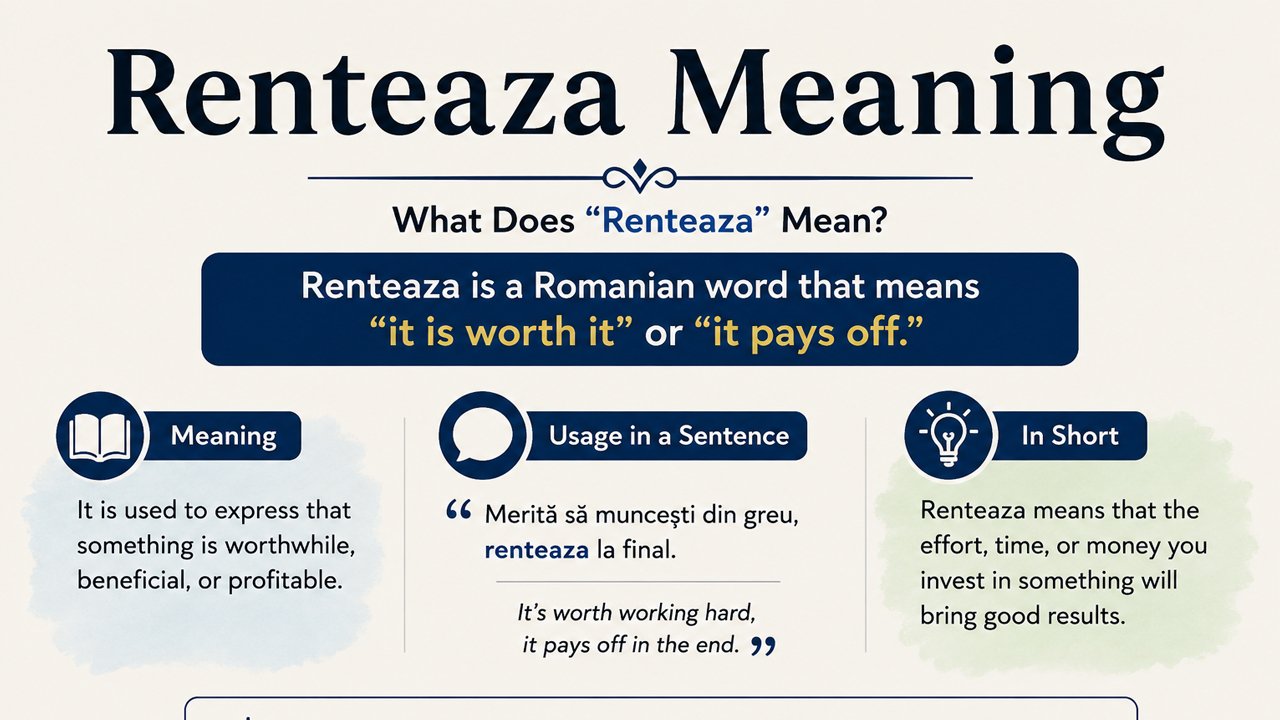
Renteaza comes from the Romanian verb “a renta,” and “rentează” is its third-person present tense form, meaning to generate income, yield a profit, or more broadly, to be worthwhile or useful, a word rooted in the French “renter” and documented in standard Romanian dictionaries. Beyond its literal dictionary meaning, the word has also been adopted as a clever brand name by several unrelated Romanian rental businesses, playing on its phonetic similarity to the English word “rent.” This article covers the word’s actual Romanian meaning, how it’s used grammatically, and the different rental businesses that have adopted it as a brand name.
What Does “Renteaza” Actually Mean?
According to Romanian dictionary sources, the verb “a renta” carries two related meanings. The primary definition describes generating income, yielding profit, or being productive, in the sense of an investment, property, or business activity that pays off financially. A secondary, more informal definition extends this to mean something merits the effort involved or is generally useful, a broader sense of “it’s worth it” beyond strictly financial contexts.
“Rentează” specifically is the third-person singular present tense conjugation, roughly translating to “it pays off,” “it’s profitable,” or “it’s worth it” depending on context. This grammatical form is commonly used in everyday Romanian conversation and writing when discussing whether a particular investment, decision, or activity is financially or practically worthwhile.
Where Does the Word Come From?
The word derives from the French verb “renter,” reflecting the historical influence of French vocabulary on Romanian, a pattern common across many Romanian words related to finance, law, and formal registers of the language, given France’s considerable historical cultural and linguistic influence on Romania particularly during the 19th and early 20th centuries. This etymology connects “rentează” to the broader family of Romance language words related to “rent” and “rente” (a French and broader European financial term referring to income from an investment or property).
This shared root also explains the word’s phonetic resemblance to the English word “rent,” a coincidental but genuinely useful overlap that Romanian rental businesses have taken advantage of in their branding, since the word sounds intuitively related to renting even to non-Romanian speakers, despite its actual core meaning being closer to “pays off” or “is worthwhile.”
How Is “Renteaza” Used as a Business Brand Name?
Multiple unrelated Romanian rental businesses have adopted variations of “Renteaza” or “RENTeaza” as a brand name, capitalizing on the clever wordplay between the word’s actual Romanian meaning and its phonetic similarity to the English “rent.” This branding approach works on two levels simultaneously: it signals profitability or worthwhileness in Romanian while also intuitively suggesting a rental service to anyone recognizing the embedded English word.
One identifiable business using this name operates as a car rental service based in Timisoara, Romania, offering vehicle rental services under the Renteaza.com domain. A separate business, “RENTeaza Studio,” operates rental accommodations and mobility services in Bucharest, including short-term apartment rentals in the IOR Park area of the city, maintaining a presence on platforms like Instagram and Airbnb, along with dedicated video content.
Are These Different Businesses Actually Related to Each Other?
Based on available information, these appear to be separate, unrelated businesses that independently adopted similar branding built around the same clever wordplay, rather than a single unified company operating across multiple cities and service types. This is a common pattern in branding: when a particular word or phrase offers an especially fitting double meaning for a specific industry, multiple independent businesses may arrive at similar naming choices without any direct connection to each other.
Anyone searching for a specific “Renteaza” branded business should verify which specific company and service they’re looking at, since the shared naming convention across genuinely separate rental businesses in different Romanian cities could otherwise create confusion about which company you’re actually engaging with for a car rental versus an apartment or studio rental. Checking the exact domain name, city, and service type listed on any booking page before proceeding is a simple way to avoid this kind of mix-up entirely.
How Does This Compare to Similar Wordplay Branding Patterns?
Using a native-language word that phonetically resembles a relevant English term is a recognizable branding strategy, particularly common in countries where English business terminology has become widely recognized even among non-fluent speakers. This approach can help a business communicate its core service intuitively to a broader audience while still resonating with native speakers on a deeper linguistic level tied to the word’s actual meaning.
This pattern appears across many languages and industries beyond Romanian rental businesses specifically, and recognizing it can help explain why certain business names might initially seem to reference one language while actually rooted in another, once you understand both the literal meaning and the phonetic wordplay at play.
What Should You Check Before Booking With a Business Using This Name?
Given that multiple separate businesses use similar branding, confirming the specific company’s official website, contact information, and service area before booking anything, whether a car rental or an apartment stay, is a reasonable practical step. Checking reviews specifically tied to the exact business and location you’re considering, rather than reviews that might apply to a different, similarly named company, helps ensure you’re evaluating the right business.
For any rental transaction specifically, verifying the company’s registration and reading its specific terms and cancellation policy before committing, standard practice for any rental booking, applies just as much here as with any other rental service, Romanian or otherwise.
Why Does Understanding the Word’s Actual Meaning Matter?
Understanding that “rentează” fundamentally means “pays off” or “is worthwhile” in Romanian, rather than being a direct translation of the English “rent,” helps clarify why the word works so well as a business name for rental services specifically: a good rental deal is, quite literally in the word’s original sense, one that “rentează,” meaning it’s genuinely worth the money. This layered meaning reflects thoughtful, culturally aware branding rather than a simple direct translation choice.
For Romanian speakers encountering this branding, the wordplay likely registers immediately and adds a layer of clever meaning beyond what an English-speaking visitor might initially catch from the surface-level phonetic resemblance to “rent” alone.
How Should You Verify a Romanian Rental Business Before Booking?
For any car rental booking specifically, checking the company’s insurance coverage, deposit requirements, and fuel policy in detail before confirming a reservation is standard practice that applies to Romanian car rental services just as it would anywhere else. Consulting general guidance on renting a car in Romania from an established travel resource can help set accurate expectations around local rental norms, required documentation, and driving regulations before you arrive.
For an apartment or studio rental booking specifically, verifying the listing through an established platform with buyer protections, such as confirming a booking directly through Airbnb’s own verified listing and payment system rather than an off-platform payment request, adds a meaningful layer of protection against booking scams, a precaution worth taking regardless of which specific Romanian rental business you’re considering or how appealing its branding sounds.
Conclusion
Renteaza traces back to the real Romanian verb “a renta,” with “rentează” meaning to pay off, generate profit, or be worthwhile, a word rooted in French influence on the Romanian language. Its clever phonetic resemblance to the English “rent” has led multiple separate Romanian rental businesses, spanning car rentals and apartment stays in different cities, to adopt similar branding independently, so confirming the specific company behind any “Renteaza” branded service you encounter is worth doing before booking anything or handing over a deposit.
Frequently Asked Questions
What does “Renteaza” mean in Romanian?
It comes from the verb “a renta,” and “rentează” means to generate income, yield a profit, or more broadly, to be worthwhile or useful. It’s commonly used in everyday Romanian to describe whether something pays off financially or practically.
Is Renteaza a single company or brand?
No. Multiple separate, unrelated Romanian rental businesses have adopted similar “Renteaza” branding, including a car rental service in Timisoara and a separate apartment and mobility rental business in Bucharest, capitalizing on the same clever wordplay independently.
Why do rental businesses use this name?
The word “rentează” phonetically resembles the English word “rent” while its actual Romanian meaning, “pays off” or “is worthwhile,” fits naturally with a rental business’s value proposition, making it an especially clever bilingual branding choice.
Where does the word “rentează” come from?
It derives from the French verb “renter,” reflecting French language influence on Romanian, particularly in financial and formal vocabulary, a pattern common across many Romanian words connected to money, investment, and business.
How do I know which “Renteaza” business I’m looking at?
Since multiple unrelated businesses use similar names, verify the specific company’s official website, exact service area, and contact details before booking, since a car rental company and an apartment rental company may share similar branding without being connected.


Is OnlyWorkMoods Com a Mood Tracker or a Content Site?

What Is MagzyMinutes.com and What Does the Site Offer?

Theboringmagazine com Guide to Finding Articles to Read

The Role of School Leaders in Creating Innovative, Inclusive, and Student-Centered Learning Environments

How Does TalkTalk Broadband Work and What Does It Include?

Voomixi Com Uses for Readers, Freelancers, and Startups

Who Is Jaisal Andrews? Inside the Life of Naveen Andrews’ Son

Who Is Tanja Rosner? The Untold Life Story of Tate McRae’s Mother

Who Is Saffron Le Bon? The Untold Life Story of Benjamin Compston’s Wife

Voozon.com Explained: What It Really Is Behind the “Knowledge Platform” Label

Who Is Sue Johnston? The Remarkable Life Story of Joel Palmentor’s Mother

Who Is Otelia Cox? The Remarkable Life Story of Tony Cox’s Wife
-
 Celebrity2 months ago
Who Is Jaisal Andrews? Inside the Life of Naveen Andrews’ Son
-
 Celebrity2 months ago
Who Is Tanja Rosner? The Untold Life Story of Tate McRae’s Mother
-
 Celebrity2 months ago
Who Is Saffron Le Bon? The Untold Life Story of Benjamin Compston’s Wife
-
 Software1 month ago
Voozon.com Explained: What It Really Is Behind the “Knowledge Platform” Label
-
 Celebrity2 months ago
Who Is Sue Johnston? The Remarkable Life Story of Joel Palmentor’s Mother
-
 Celebrity2 months ago
Who Is Otelia Cox? The Remarkable Life Story of Tony Cox’s Wife
-

 Celebrity2 months ago
Who Is Kerri Browitt Caviezel? The Inspiring Life Story of Jim Caviezel’s Wife
-

 News2 months ago
Money6x.com: What This Personal Finance Platform Offers