Business
Zero Markup: What Adding $0 Per Token Does to a $10,000 Bill

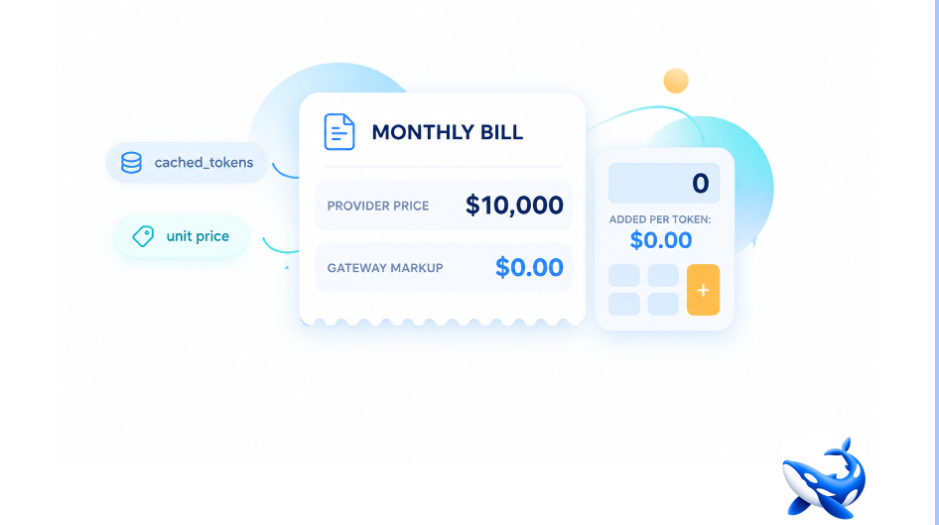
“Zero markup” reads like a slogan until you do the arithmetic, so do the arithmetic. Most AI gateways add between 5% and 20% on every token; the going statement is that most AI gateways add 5–20% on every token, and OrcaRouter answers it by adding nothing at all. Its zero markup page puts the claim in two short sentences — “You pay each provider their exact list price. We add $0 per token” [OURS, read 2026-10-15] — and this article is about what those two sentences mean against a real monthly bill.
Take a team that spends $10,000 a month on model tokens through a gateway that adds a markup. At 5%, the gateway keeps $500; at 20%, it keeps $2,000. Both numbers are the cost of the routing layer sitting on top of tokens that the providers themselves already priced. On the same $10,000 of spend, a $0-per-token policy means that column is always zero. That is not a small discount — it is the difference between paying for tokens and paying for tokens plus a margin.
The three “no” clauses that make the claim checkable
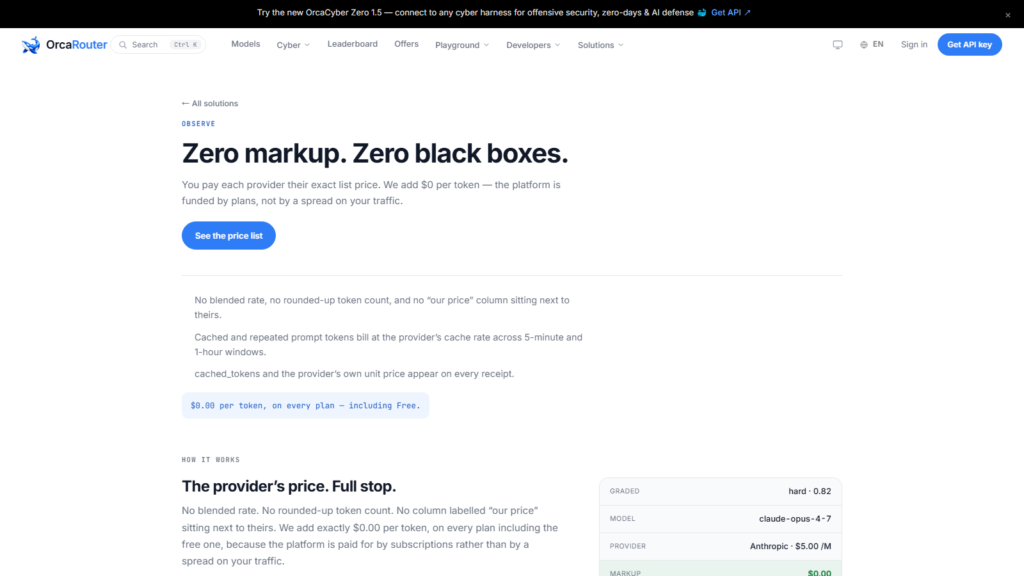
A promise to charge $0 is worth nothing if the invoice is structured so the extra is invisible. The page closes that door with three specific statements: no blended rate, no rounded-up token count, and no column labelled “our price” sitting next to the provider’s [OURS, read 2026-10-15]. Each of the three is a distinct way a hidden margin could survive, and each is ruled out by name.
A blended rate merges many providers and models into one average price per token; with no blended rate, the price you see is the price of the specific model that served the request. Rounded-up token counts inflate usage before multiplication, which is the quietest of the three because it never changes the visible rate; the page says token counts are not rounded up. A parallel “our price” column would create a second, higher number to bill against while the provider’s own rate stays on the left; the page says that column does not exist. All three clauses are on one page, and they are the difference between a slogan and a mechanism.
One row from the pricing table, line by line
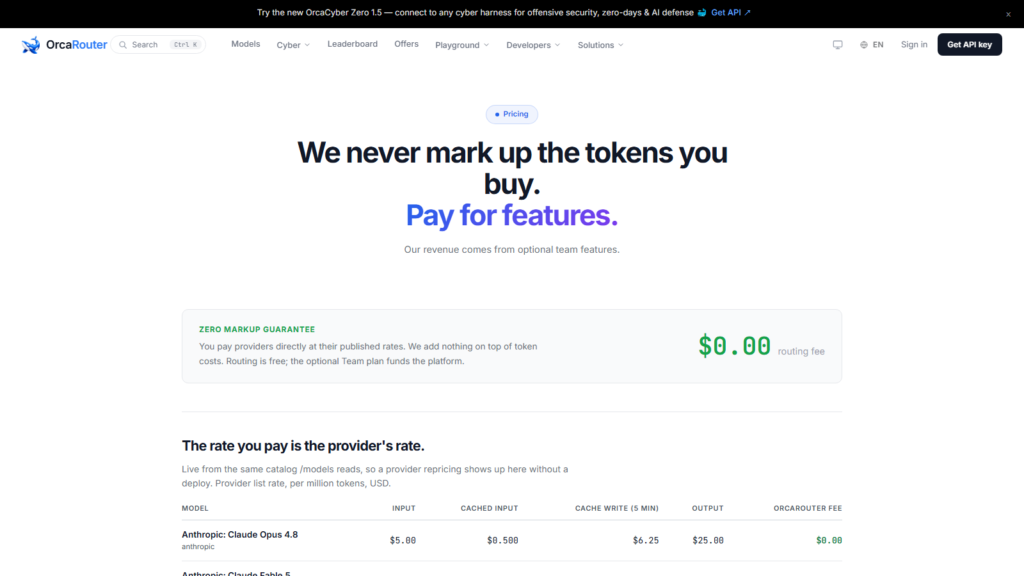
The mechanism becomes concrete on the pricing page, which lists the same catalogue the model pages serve, live, with a provider repricing showing up without a deploy [OURS, read 2026-10-15]. One sample row: Anthropic’s Claude Opus 4.8 at $5.00 per million input tokens, $0.500 per million cached-input tokens, $6.25 for a five-minute cache write, and $25.00 per million output tokens [VENDOR]. The “OrcaRouter fee” column is next to that row, and it is the column that is always $0.
Watch the cached-input number do the work. $0.500 is the provider’s own discounted cache rate, passed through unchanged rather than kept. On a workload that re-reads the same context repeatedly — a long system prompt, a large codebase prefix — the difference between paying the cache rate and paying the full input rate is where the real savings sit, and it is exactly the kind of line a markup would quietly swallow. The zero-markup page states the rule: cached and repeated prompt tokens bill at the provider’s cache rate across 5-minute and 1-hour windows [OURS].
The two cache windows matter because providers do not price them the same. The pricing page notes that Anthropic’s 1-hour cache writes bill at 1.6x the 5-minute rate shown [VENDOR, read 2026-10-15] — so on the Opus 4.8 row, a five-minute cache write is $6.25 per million tokens, and the one-hour variant is higher still. The point for the reconciliation is not the exact multiple; it is that the provider’s own tiering survives intact. A gateway with a blended rate has no room for a cache tier that changes by provider and by window. A pass-through price table keeps every one of those rows visible, which is precisely what makes the bill re-auditable.
A receipt you can reconcile one call at a time
The final piece is the receipt. The page states that `cached_tokens` and the provider’s own unit price appear on every receipt [OURS, read 2026-10-15]. That pairing is what makes the zero-markup claim verifiable: each request shows the grade, the model that served it, the provider behind it, the unit price they charge, and the tokens that came from cache [OURS]. Cost stops being a number you reconcile at month end and becomes something you can read one call at a time.
Reconcile the $10,000 bill with receipts in that shape and the check is trivial: multiply each row’s token counts by the provider’s unit price, add the `cached_tokens` at the cache rate, and the total should be exactly what you were billed. If a gateway keeps a blended rate or a rounded count, that multiplication fails somewhere; if there is no markup, it never does. The receipt is the audit, and the audit is the claim.
The pricing page, and the fee column next to every row
The pricing page makes the same promise in a different form: a $0.00 routing fee [OURS, read 2026-10-15], and the FAQ statement that there is no per-request fee on the Hacker or Team plans [OURS]. The free tier is the full gateway — 200+ models, one OpenAI-compatible API, and automatic failover [OURS] — which is the honest way to run the arithmetic: the product is funded by optional team subscriptions, not by a spread on your traffic [OURS]. When the revenue model is a subscription, the incentive to build a margin into the token price disappears, and the price column can be left alone.
The two costs that survive a zero-markup policy
Zero markup removes the gateway’s margin, but it does not remove two other costs you should keep on the table. First, the providers’ own prices are exactly what they are — a $0 gateway policy does not make a frontier model cheap, it makes it honest. Second, latency and retries still cost what they cost in wall-clock time; a routing layer that adds under a millisecond by default [OURS] is not the same as a routing layer that adds nothing at all, only a markup that is always zero.
None of that weakens the arithmetic. The markup column on your bill is a pure cost — it buys no tokens, no quality, no capacity. At 5–20% it silently competes with every other line item on the invoice. The number this article started with is the whole argument: $500 to $2,000 on a $10,000 month, depending on the markup rate, all for tokens you already paid for once.
The takeaway
Zero markup is only meaningful if you can verify it, and the verification lives in the shape of the bill: no blended rate, no rounded-up token count, no parallel price column, cached tokens billed at the provider’s cache rate, and every receipt carrying `cached_tokens` next to the provider’s own unit price. On a $10,000 monthly bill, a 5–20% markup means $500–$2,000 that buys no tokens; a $0-per-token policy means that column is always zero and the receipts let you prove it. The claim was never that tokens are free — it is that you pay for them exactly once.
Sourcing note: the two-sentence zero-markup statement, the three “no” clauses, the 5-minute and 1-hour cache windows, the cached_tokens receipt fields, the $0.00 routing fee, the no-per-request-fee FAQ answer, the free-tier feature list and the under-1ms routing figure are OrcaRouter’s own product copy and configuration descriptions, read from the zero-markup and pricing pages on 2026-10-15 [OURS]. The Claude Opus 4.8 prices — $5.00 per million input, $0.500 per million cached input, $6.25 per five-minute cache write and $25.00 per million output — are the provider’s published list rates as reproduced on the pricing page [VENDOR]. The “most AI gateways add 5–20%” statement is cited from the pricing page as a general industry observation and no platform is named [INDEPENDENT]. No third-party benchmark or market figures are used. Telemetry figures are rolling and will drift. Read 2026-10-15.


The Road to Super Bowl 2027: Teams and Players to Watch

From 1-Bedders to Multi-Gen Layouts: 6 Takeaways on One Chuan Grove

Lash Lift in Tucson: Exploring the Benefits of This Popular Beauty Treatment

Everyone Has a Safety Policy. Why Are Workers Still Afraid to Speak Up?

When Your Brand Name Collides With a Prior Mark: A Practical Framework for Trademark Clearance and Next Moves

How to Get the Most From a Chef’s Counter Tasting Menu

What Is OpenSkyNews and Who Are Its Two Co-Founders?

Who Is Tanja Rosner? The Untold Life Story of Tate McRae’s Mother

Who Is Jaisal Andrews? Inside the Life of Naveen Andrews’ Son

Who Is Saffron Le Bon? The Untold Life Story of Benjamin Compston’s Wife

Who Is Kerri Browitt Caviezel? The Inspiring Life Story of Jim Caviezel’s Wife

Who Is Otelia Cox? The Remarkable Life Story of Tony Cox’s Wife
-
 Entertainment3 months ago
What Is OpenSkyNews and Who Are Its Two Co-Founders?
-
 Celebrity3 months ago
Who Is Tanja Rosner? The Untold Life Story of Tate McRae’s Mother
-
 Celebrity3 months ago
Who Is Jaisal Andrews? Inside the Life of Naveen Andrews’ Son
-
 Celebrity3 months ago
Who Is Saffron Le Bon? The Untold Life Story of Benjamin Compston’s Wife
-
 Celebrity3 months ago
Who Is Kerri Browitt Caviezel? The Inspiring Life Story of Jim Caviezel’s Wife
-
 Celebrity3 months ago
Who Is Otelia Cox? The Remarkable Life Story of Tony Cox’s Wife
-

 Celebrity3 months ago
Who Is Sue Johnston? The Remarkable Life Story of Joel Palmentor’s Mother
-
 Software2 months ago
Voozon.com Explained: What It Really Is Behind the “Knowledge Platform” Label