Technology
BMW N47 vs N57: Which Diesel Engine Makes More Sense for Used Buyers?

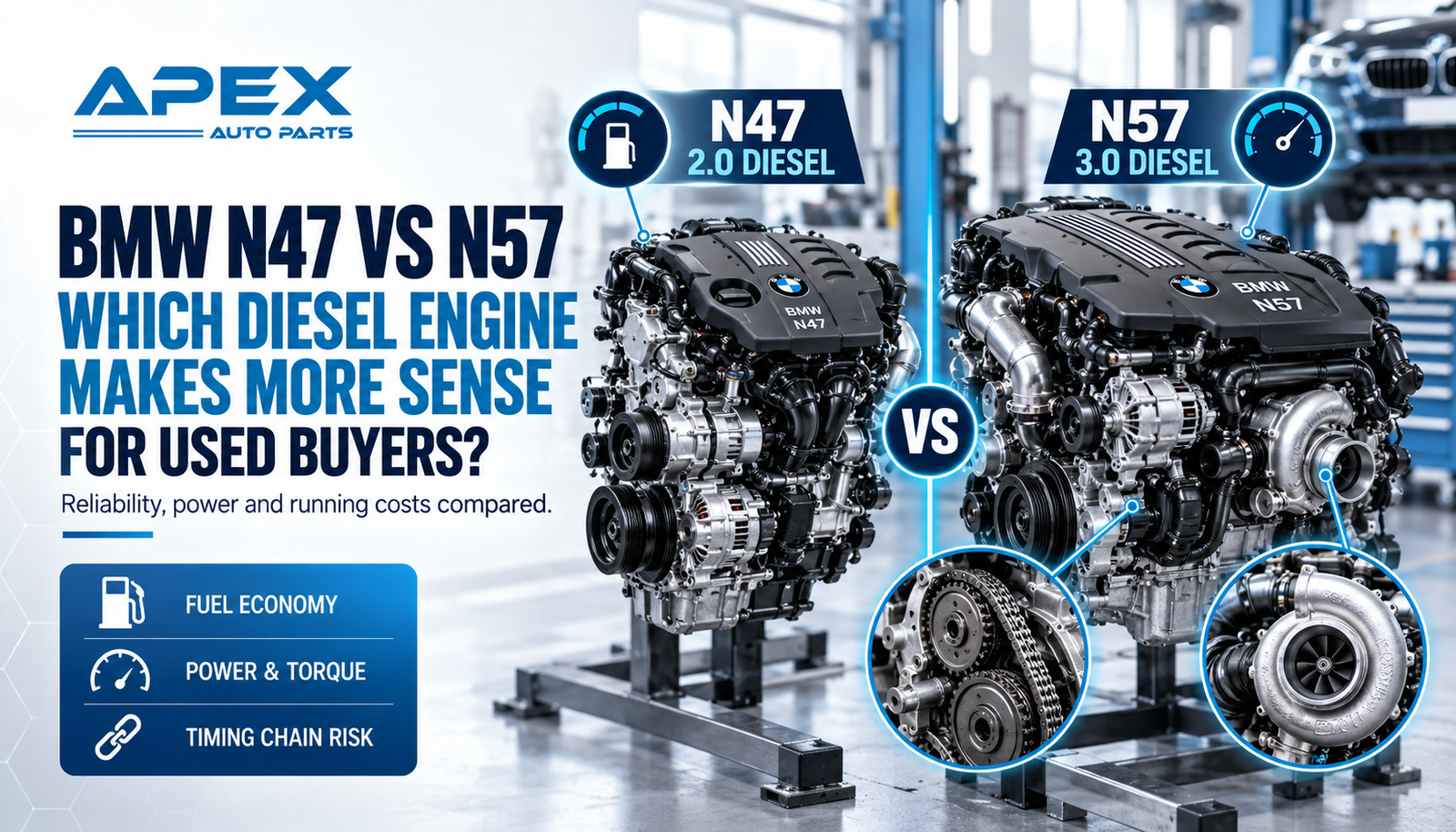
BMW’s N47 and N57 diesel engines powered some of the brand’s most popular cars. Both offer strong torque and good fuel economy, but they suit different drivers and come with different ownership risks.
The N47 is mainly a 2.0 litre four-cylinder diesel. It was fitted to cars such as the BMW 1 Series, 3 Series, 5 Series and several X models. The N57 is a larger 3.0-litre straight-six diesel found in models such as the 330d, 530d, 730d, X3 and X5.
On paper, the choice looks simple. The N47 is cheaper to run, while the N57 is smoother and more powerful. In practice, service history, driving pattern, and previous repairs matter just as much as the engine design.
How Are the N47 and N57 Different?
The N47 was designed to give everyday BMW models useful performance without using too much fuel. One well-known version produced around 184 hp and 380 Nm, which was enough to make cars such as the 120d and 320d feel quick on UK roads.
The N57 was built for larger and more powerful BMW models. Early versions produced around 245 hp and 540 Nm, while later versions offered 258 hp and 560 Nm. Stronger versions used more advanced turbo systems and could produce more than 300 hp.
Two extra cylinders make the N57 smoother than the N47. It produces less vibration and delivers its power with less effort. This is especially noticeable when overtaking, climbing hills, or carrying passengers.
The N47 feels more like a normal economy diesel. It still has strong low-speed pulling power, but it does not have the same smoothness or reserve of performance as the N57.
Which Engine Offers Better Performance?
The N57 is the clear winner for power. Even the normal 30d versions provide enough torque to move a large 5 Series or X5 without feeling strained.
A healthy N57 responds strongly from low engine speed and continues pulling without needing constant gearbox changes. This makes it very well suited to motorway travel.
The N47 is still fast enough for most drivers. In a lighter 1 Series or 3 Series, it provides good acceleration while using less diesel. It can be the more sensible choice for commuting and regular family driving.
Drivers should remember that output varies between versions. BMW used different turbochargers, software, and fuel system components across the N47 and N57 families. The engine code, production year and original specification should always be checked before comparing two cars.
N47 and N57 Fuel Economy
Fuel economy is one of the strongest reasons to choose the N47. Its smaller capacity and four-cylinder layout mean it normally uses less fuel than the N57.
During steady motorway driving, a well-maintained N47 can deliver excellent economy. This can make a large difference for somebody covering 15,000 or 20,000 miles each year.
The N57 uses more fuel, particularly in urban traffic. However, its economy can still be impressive for a 3.0 litre engine with strong performance. A 530d driven carefully on a long journey can provide respectable fuel consumption while remaining much quicker and smoother than a four-cylinder diesel.
The right choice depends on what the driver values. The N47 usually wins on fuel cost. The N57 offers more performance for each gallon used.
Why Does the N47 Timing Chain Have Such a Poor Reputation?
Timing chain failure is the problem most strongly connected with the BMW N47 engine. The chain is positioned at the rear of the engine, close to the gearbox. This makes access difficult and increases labour costs.
Wear may cause a metallic rattling or scraping sound, particularly during a cold start. The sound should never be ignored. If the chain fails, the pistons and valves may collide and cause serious internal engine damage.
Not every N47 will suffer timing chain failure. Many engines have covered high mileage without major trouble. The risk becomes more concerning when there is no proof of regular oil servicing or when the engine already produces suspicious noise.
A used N47 with detailed service records and documented timing work can be a much safer purchase than a lower mileage car with no invoices.
Can the N57 Develop Timing Chain Problems?
The N57 also uses a rear-mounted timing chain arrangement. It should not be treated as free from timing chain wear simply because it has a better reputation than the N47.
A cold start remains one of the most useful checks. The engine should settle into a smooth idle without a persistent metallic rattle. Any unusual sound from the rear of the engine deserves attention from a BMW diesel specialist.
Regular oil changes are important for both engines because the chain, guides, and tensioner depend on clean lubrication. Long gaps between services may increase wear throughout the engine, not only in the timing system.
The N57 generally has a less worrying timing chain reputation, but its condition still needs to be checked individually.
DPF and EGR Problems
Both engines can suffer from diesel particulate filter and exhaust gas recirculation problems. These systems work best when the car regularly completes journeys long enough to reach full operating temperature.
Repeated short trips can prevent the DPF from completing regeneration. Soot then builds inside the filter until a warning light appears or engine power is reduced.
An EGR fault can cause rough running, hesitation, smoke, or reduced power. Carbon and oily deposits may also collect inside the intake and restrict airflow.
A blocked DPF should not automatically be replaced. A faulty thermostat, exhaust sensor or EGR component may be stopping regeneration. The original fault must be found, or the replacement filter may become restricted again.
Neither engine is ideal for a driver who only completes short urban journeys. A petrol BMW may be a better choice in that situation.
Turbocharger and Boost System Faults
N47 and N57 engines use turbocharging, but the exact arrangement depends on the version. Standard engines may use one turbocharger, while higher output N57 models can have more complex systems.
Weak acceleration, smoke, and unusual whistling may suggest a turbo problem. However, these symptoms can also be caused by a split hose, leaking intercooler connection, faulty actuator, or damaged pressure sensor.
The complete boost system should be tested before an expensive turbocharger is ordered. A pressure or smoke test can often find a leak that is difficult to see.
Higher output N57 versions deliver impressive performance, but their extra turbo equipment can increase repair costs. A normal 30d is often the safer choice for buyers who want strong performance without the most complicated setup.
Injector and Fuel System Costs
Both engines use high-pressure common rail fuel injection. Failed injectors can cause difficult starting, rough idle, smoke, or poor acceleration.
The N47 has four injectors, while the N57 has six. This means a complete set for the N57 can cost considerably more.
Injectors should be tested rather than replaced based only on symptoms. Poor compression, incorrect fuel pressure, EGR faults, and air leaks can all make a diesel engine behave in a similar way.
Fuel contamination can also damage the high-pressure pump and spread debris through the system. This can turn one failed component into a much larger repair.
Running Costs Beyond the Engine
A used BMW should not be judged only by its engine. The additional torque produced by an N57 can place more load on the automatic gearbox, differential, driveshafts, and transfer case in Four Wheel Drive models.
A tuned car deserves even more attention. Extra torque may feel impressive, but it can increase stress on the gearbox and drivetrain. Buyers should ask who carried out the remap and whether the car received more frequent maintenance afterwards.
Tyres, brakes and suspension may also cost more on the larger BMW models that use the N57. The engine may be reliable, but the complete vehicle can still be expensive to maintain.
The N47 is normally fitted to lighter and less powerful cars. Routine servicing, tyres and other wear items are therefore often cheaper.
What Should You Check Before Buying?
A proper inspection should include more than a short drive around the block.
Useful checks include:
- Start the engine when it is completely cold.
- Listen for timing chain rattles or scraping.
- Check invoices for regular oil and filter changes.
- Look for oil and coolant leaks.
- Test acceleration to boost hesitation.
- Check DPF, EGR, and fuel system data with diagnostic equipment.
- Make sure the gearbox changes smoothly when warm.
- Inspect the car for signs of poor tuning or removed emissions equipment.
- Confirm any claimed timing chain or turbo work with invoices.
A clean engine bay does not prove that an engine is healthy. Detailed records and a professional inspection are far more valuable.
Choosing the Correct Replacement Parts
There are several versions of both engine families, so parts should never be ordered using only a description such as “BMW 2.0 diesel” or “BMW 3.0 diesel”.
Turbochargers, injectors, timing components, sensors, and emissions parts may change according to the engine code, production date, and power output.
Suppliers such as Apex Auto Parts can use the registration, VIN, engine code and original part number to help match the correct component. This is especially important when the repair involves costly parts or significant labour.
A cheap component is not good value if it does not fit correctly or fails soon after installation.
N47 or N57: Which One Should You Choose?
The N47 makes more sense for drivers who want strong fuel economy and lower routine servicing costs. It works particularly well in lighter BMW models and can cover high mileage when maintained properly.
Its timing chain history remains the main concern. A cheap N47 with chain noise and no service records can quickly become an expensive project.
The N57 is the better engine for smoothness, torque, and long-distance performance. It suits larger BMW models and makes motorway driving feel effortless. Its better timing chain reputation is another advantage, but repairs can cost more because it has six cylinders and more components.
For most enthusiasts, the N57 is the more desirable engine when the additional running cost is affordable. For drivers focused on fuel economy, a quiet and well-maintained N47 can still be an excellent choice.
The deciding factor should always be condition. A carefully serviced N47 with documented timing work is a safer purchase than a neglected N57 with injector, turbo, and DPF problems.


Who Is Sol Xochitl? The Inspiring Life Story of Exodus Tyson’s Mother

Who Is Sherry Aon? The Untold Story Behind Rick Gonzalez’s Wife

Who Is Krista Visentin? A Closer Look at the Amazing Life of David Visentin’s Wife

How to Prepare Your Travel Declaration Before Visiting Another Country

Who Is Aliza Barber? The Remarkable Life of Lance Barber’s Wife

Who Is Korina Harrison? The Truth Behind Corey Harrison’s Ex-Wife

Who Is Tanja Rosner? The Untold Life Story of Tate McRae’s Mother

Who Is Jaisal Andrews? Inside the Life of Naveen Andrews’ Son

Who Is Saffron Le Bon? The Untold Life Story of Benjamin Compston’s Wife

What Is OpenSkyNews and Who Are Its Two Co-Founders?

Who Is Kerri Browitt Caviezel? The Inspiring Life Story of Jim Caviezel’s Wife

Who Is Otelia Cox? The Remarkable Life Story of Tony Cox’s Wife
-
 Celebrity3 months ago
Who Is Tanja Rosner? The Untold Life Story of Tate McRae’s Mother
-
 Celebrity3 months ago
Who Is Jaisal Andrews? Inside the Life of Naveen Andrews’ Son
-
 Celebrity3 months ago
Who Is Saffron Le Bon? The Untold Life Story of Benjamin Compston’s Wife
-
 Entertainment2 months ago
What Is OpenSkyNews and Who Are Its Two Co-Founders?
-
 Celebrity3 months ago
Who Is Kerri Browitt Caviezel? The Inspiring Life Story of Jim Caviezel’s Wife
-
 Celebrity3 months ago
Who Is Otelia Cox? The Remarkable Life Story of Tony Cox’s Wife
-

 Celebrity3 months ago
Who Is Sue Johnston? The Remarkable Life Story of Joel Palmentor’s Mother
-

 Software2 months ago
Voozon.com Explained: What It Really Is Behind the “Knowledge Platform” Label